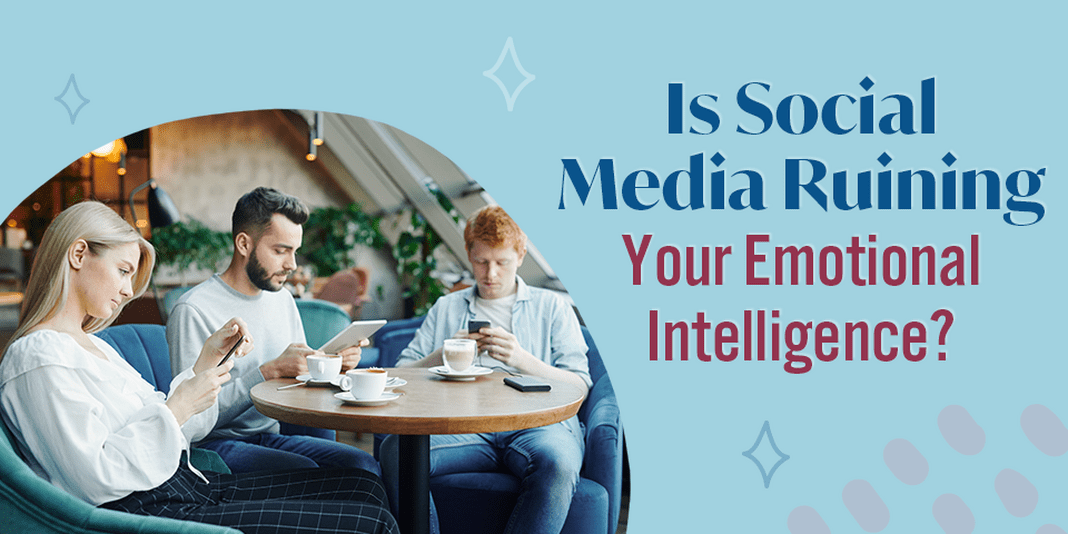
Is Social Media Ruining Your Emotional Intelligence?
It’s a typical Wednesday evening. The TV’s on, but you’re hardly paying attention to it. You idly reach for your phone and start app-hopping. TikTok becomes Instagram becomes Reddit, and you just can’t get enough. Each new platform provides you with juicy content, but at what cost?
Brace yourself, because it may be greater than you think. Emerging research suggests that high social media use could be chipping away at your emotional intelligence (EQ), lowering your capacity for patience and empathy in real-world relationships and making it easier for you to be “cruel at a distance.” We asked two experts to explain what’s happening and how you can protect yourself.
Social Media vs EQ, An Unfair Fight?
Emotional intelligence, or EQ, is the ability to identify, understand and manage our own emotions and those of others. We use it constantly and in many ways, not just to process our own feelings, but also in how we interpret the feelings and behavior of the people around us.
As registered psychologist Amberley Meredith from the Being Well Process puts it, “EQ shapes how we communicate, both with ourselves and with others.”
While there are various models that seek to explain EQ, for the purposes of this article, we’ll be focusing on the most recent model developed by Truity. Truity’s Emotional Intelligence (EQ) test measures your competence in five key areas:
- Self-awareness: the ability to recognize what you’re feeling and understand why you’re feeling it.
- Social Awareness: the ability to read other people’s emotions, needs and cues, and to understand the dynamics in a group or relationship.
- Emotional Control: the ability to manage impulsive feelings and regulate your emotional response so you can act intentionally rather than react automatically.
- Empathy: the capacity to understand how another person feels and to respond in a way that reflects that understanding.
- Emotional Wellbeing: the sense of balance and resilience that comes from understanding and managing emotions in healthy ways.
What’s interesting about EQ is that, unlike Myers-Briggs and other personality models, your EQ can and does change naturally, both in different situations and over the course of your lifetime. The things you do, people you meet, and lessons you learn all shape how emotionally intelligent you are at any given point.
Your social media habit definitely fits into this picture. These platforms are optimized for rapid content consumption and high-speed, often superficial, interactions to maintain engagement and profit. When doom-scrolling, influencer culture and online echo chambers replace deep, in-person interactions, people’s EQ can be at real risk. There’s plenty of evidence now that it can erode your EQ skills, and too much usage could dramatically shift how you connect to the world around you and the people in it—including yourself.
What Happens When We Stop Reading the Room
Social awareness is the ability to pick up on how someone else is feeling before they say a single word. It could be how they’re standing, their tone of voice, a micro-expression, or just their overall mood.
Those small, in-person signals are exactly what social media struggles to capture. So while you can absolutely have a heartfelt conversation with someone online, a lot of the information we rely on to “read the room” simply isn’t there. Without being physically present with other people, when all we see is text and images, we get fewer chances to build the skills that help us pick up on those cues.
“The more time we spend engaging with social media, the less time we may spend investing in offline relationships,” says Corey Emanuel, media psychologist at Coach Corey Consulting. He says that in-person face time is essential for us to practice reading facial expressions, tone and other emotional cues and, when we don’t have that practice, it becomes harder for us to notice what others are feeling. Being habitually online can also weaken empathy and the emotional connection that helps us respond with care.
Empathy, another facet of EQ, is responsible for how deeply we relate to other people’s feelings. Empathy allows us to “walk in their shoes” and, according to new research, social media could be making us more than a little “rusty” in our empathy skills.
In one study, researchers asked over 1,250 Americans to estimate how often they used Facebook, Instagram and Twitter (now X), and participants also completed a questionnaire designed to measure their empathy. The results painted a worrying picture: the more social media someone used, the lower their empathy.
But in an interesting paradox, studies from other countries have found the exact opposite, with higher social media use linked to higher empathy. Differences in how people use social media across cultures may help explain why the results vary from place to place, but we need more research to understand why different countries have such different results. Emanuel says that, for now, “The strongest conclusion we can draw is not that social media has one single effect on empathy, but that its impact depends on who is using it, how they are using it, and what kind of social environment it creates.” Basically—the impact isn’t one-size-fits-all.
What Happens When Your Feed Agrees With You
While social awareness and empathy are other-oriented skills, self-awareness and emotional control are more about understanding and managing our own reactions. Self-awareness is the ability to notice and question your own emotional experiences when you need to. Emotional control is about managing those feelings so you respond thoughtfully, rather than reacting on impulse.
Both rely on honest self-reflection, which can be harder if you’re a frequent social media user.
Social media often reflects your own beliefs and opinions back at you, sometimes over and over again. Algorithms intentionally show us content that matches our existing beliefs and views because it wants our likes and shares. That ‘echo chamber’ can feel comforting, but it’s dangerous. As Meredith explains, it leads to confirmation bias which “pulls us towards people and ideas that feel familiar, but could limit our exposure to alternative perspectives that could challenge our thinking.” In other words, social media has the power to trick you into thinking the whole world feels just like you.
When your feed keeps validating how you feel and react, it can become harder to step back and examine your emotions clearly. Meredith says that ideas like “I’m entitled” or “I deserve” may start with a helpful intention, but when they are repeated and reinforced, they can harden into a more rigid way of thinking. And self-awareness depends on flexibility—the ability to pause and examine your own perspective—which starts to erode when everything you feel is constantly validated. At that point, it becomes easier to focus on your own wants and harder to recognize the shared responsibility you have with other people.
Once that happens, emotional control can suffer too. If you’re used to being told you’re right, then you automatically feel that your reactions—even the snap judgments and knee-jerk responses—are justified. You’re less likely to soften your response or weigh how it lands on other people. “Without the nuance of recognizing how our behavior impacts others, this can strain relationships, create division, and build resentment,” Meredith says.
The Toll on Your Wellbeing
Emotional wellbeing is the broadest of our five EQ factors. It describes your overall state of psychological, emotional and social wellness, all of which can take a hit with excessive social media use.
What we’re talking about here is social anxiety, which Meredith defines as “a fear of being around other people, speaking up, putting in boundaries, or being vulnerable.” Social anxiety is an intense fear of being judged or scrutinized in social situations, and it’s often the precursor to FOMO and the constant need to compare yourself with others.
How social media affects social anxiety often comes down to how you use it. A 2023 study looking at more than 1,700 college students found that passive social media use, like scrolling without interacting, was linked to higher social anxiety. Active use, such as commenting and engaging with others, actually had the opposite effect.
Why is passive scrolling the more dangerous habit? Researchers think it’s down to social media envy. Social feeds are full of curated versions of people’s lives, the highlight reels of the beautiful family, career success and exotic vacations. The more of that content we take in, the more likely we are to measure ourselves against it and come away feeling like we’re falling short.
“Social media can contribute to social anxiety not just by increasing fear of judgment, but by shaping how we perceive ourselves and others,” says Meredith. Social media can make people think worse of themselves, and this “can make it harder to engage openly, respond flexibly, and maintain balanced, healthy long-term relationships.”
How to Protect Your EQ in the Age of Social Media
Going cold turkey on social media is unrealistic for most of us, but it’s possible to engage with it in ways that protect and even strengthen your EQ. Here’s what our experts recommend:
Limit your social media use
Stepping away from social media reduces the constant social comparison, leading to better self-acceptance and emotional control. A 2018 University of Pennsylvania study found that limiting your overall social media use to just 30 minutes a day could lead to a “significant improvement in wellbeing.”
Be a more active user
It sounds counterintuitive but the existing research suggests that passive use is more likely to result in social anxiety. Participating more actively and building genuine connections can help combat this by recreating some of the emotional exchange we miss offline.
Pause and ask ‘why’
If something triggers you emotionally online, pause before reacting. Are you being manipulated into feeling a certain way? Is your first response a genuine response, or are you being swept along by the moment? Would you react the same way in a real-life conversation? Asking these questions will help you to practice self awareness, and understand what could be causing the reaction before you comment something you might regret.
Keep IRL socializing
One of the biggest ways that social media can impact your EQ is by pulling you away from in-person interactions where you get natural exposure to emotional cues, different viewpoints, and the reality checks that keep your perspective grounded. While social media can be a way to connect with people, it shouldn’t be the only option. Focus on real-life socializing as a way to sharpen your EQ skills across the board.
Ultimately, deleting your apps is unlikely to be the most realistic way to protect your EQ. Just be conscious that your EQ may be suffering and make whatever changes you can to avoid the darker side of these platforms. Your best defense may not be less screen time, but staying just as close to the offline relationships and real-life feedback that social media can’t fully replicate.


