What Enneagram Type Are You at Your Worst? The Stress Arrows Explained
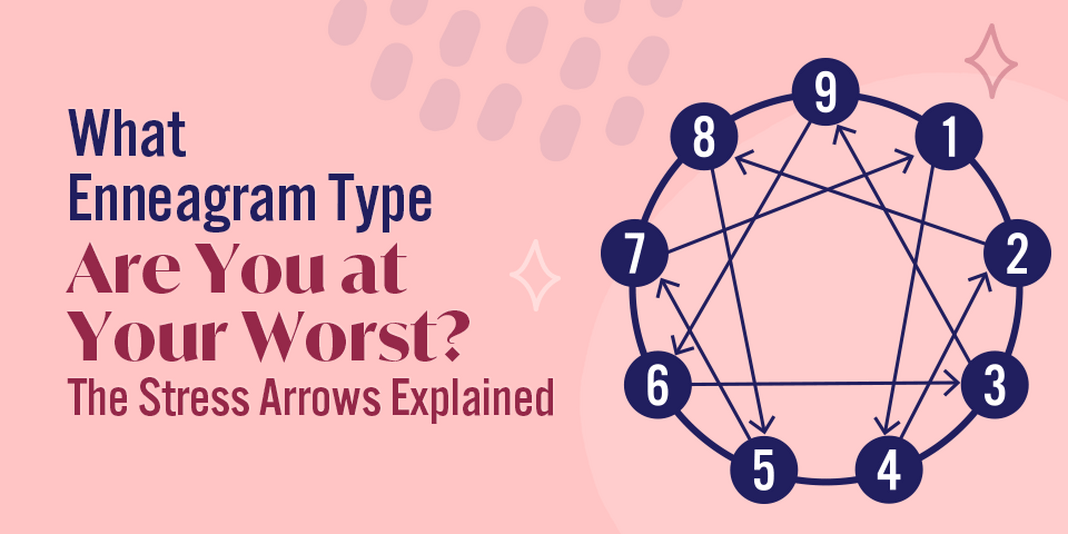
The Enneagram symbol, which many link to the followers of the Greek mathematician Pythagoras, includes not just numbers but arrows. They help explain how we behave under stress and when we are relaxed.
When I began my Enneagram education in 1995, the arrows were described in dramatic terms. You were either on your “path of integration” (good) or your “path of disintegration” (bad). By the early 2000s, the Enneagram community largely agreed the language was doing more harm than good, so we softened it: the forward arrow became the “stress point,” and the reverse arrow became the “security point.” More recently, leading teachers Beatrice Chestnut and Uranio Paes have reframed both arrows as growth opportunities, renaming them the “energizing point” and the “resolution point.”
The terminology keeps evolving, but the underlying concept stays the same. Under pressure, each of us shifts into a recognizable pattern of behavior that belongs to a different Enneagram type. We don’t become that type, but we borrow some of its qualities.
In the case of the forward arrow (formerly the stress point now reframed as the resolution point), we typically adopt the less positive traits of that type. But within this arrow lies a hidden opportunity. With enough awareness, we can leverage this connection to adopt the high side of the type, rather than default to the low.
Let’s have a closer look at the stress arrows and how to use them as part of your growth path.
Type One: The Perfectionist Slides to Type Four
Under stress, the usually restrained, emotionally contained improver of the Enneagram slides toward the less healthy aspects of Type Four. Their thinking becomes more neurotic, their emotional stability wobbles and the to-do lists that usually ground them start to feel meaningless.
When this happens, the emotional discipline that Type Ones are known for cracks, often suddenly and visibly. Remember how Hillary Clinton (widely believed to be a Type One) choked up on the 2008 campaign trail when asked how she kept up the pace? Her voice broke as she spoke about how much she cares about her country. Hers is an example of how moving to your stress point isn’t a bad thing. Her breakdown humanized her and is said to have helped her win in New Hampshire the following day.
The Growth Opportunity in Emotionality: Type Ones grow by learning to access their heart and emotions before stress forces the issue. The Type Four arrow gives them a direct line to the feelings that underpin their drive for good. Expressing those feelings, as Clinton's moment showed, can be more powerful than any amount of self-discipline.
Type Two: The Giver Moves to Type Eight
People are often shocked to see the fiery side of a Type Two under stress. The Givers of the Enneagram suddenly become combative, direct and downright unfriendly. For someone who is usually so kind and considerate, the change can feel abrupt, like a switch was flipped, and it can be memorable.
This looks like the kind-hearted volunteer who suddenly screams at a vendor or the normally docile parent who has harsh words for their child’s volleyball coach. Dolly Parton, widely loved and typed as a Two, illustrated her connection to Type Eight in a 2023 TalkShopLive interview: “Sometimes you've just kind of gotta pitch a fit to get it done or get it done right. I don't lose my temper, but I use my temper,” she said, adding that she gets particularly angry if someone's messing with her family or her work.
The Growth Opportunity in Anger: For Type Twos, the move to Eight isn't inherently negative. Accessed healthily, that arrow gives them permission to set boundaries and be more assertive deliberately, in service of what matters — something Twos rarely grant themselves.
Type Three: The Achiever Retreats to Type Nine
Under stress, the goal-oriented, image-conscious Achiever of the Enneagram does something that surprises everyone, including themselves. They move to sloth. The engine that normally runs at full throttle stalls out, and they become disengaged and oddly passive. This might be your Type Three friend who loses themselves in video games or drops out of the social circle.
A client I’ll call Mark collapsed during a relationship break up, barely able to leave his sofa. His ambition drained out of him, and he had a hard time even showing up for work. For a high profile example, look to singer Taylor Swift, widely recognized as a Type Three, who built one of the most successful careers in music history. Following a very public feud with Kanye West and Kim Kardashian in 2016, she disappeared. “Nobody physically saw me for a year,” she said later in her documentary Miss Americana. Under stress, Type Threes disappear.
The Growth Opportunity in Sloth: One step along the growth path for Type Threes is to learn to be still, and their connection to Type Nine lights the way to doing less. If they can take their move to inaction as an invitation to understand their worth, even when they aren’t achieving, it can be part of their inner growth.
Type Four: The Individualist Moves to Type Two
When overwhelmed, Type Fours make the unexpected journey to the low side of Type Two. The Individualists of the Enneagram already have high emotional fluency but now they may, consciously or subconsciously, become manipulative to get their own needs met, or they might get overly involved in things that are not their concern. This is a Type Four who engages with others but with a stickiness that implies they want something out of the interaction. Or they become gossipy and nosy about the lives of those close to them.
However, the arrow can also manifest in a more positive direction as Angelina Jolie, widely typed as a Type Four, illustrates. She describes her early humanitarian work in Sierra Leone, “I felt completely overwhelmed. I cried constantly. I felt guilty for everything that I had. Then I realized I wasn't doing these people any favors by crying. I kept getting angry at the injustices until I couldn't think straight. I took a deep breath and focused on how I could help. I discovered that I was useful as a person.”
The Growth Opportunity in a Focus on Others: The focus on others can actually be healing for Type Fours as their intense self-absorption is replaced with a focus on other people. When the focus becomes concrete help, rather than an armchair quarterback commenting on how other people should live their lives, the connection to Type Two can be an asset.
Type Five: The Investigator Goes to Type Seven
Under stress, the reserved, data-driven Type Five becomes uncharacteristically scattered and unfocused. The Investigator of the Enneagram, who normally thinks before speaking, starts generating ideas faster than they can process them, bouncing between projects and making impulsive decisions they would usually take weeks to research. It can be confusing to witness, and even more disorienting to experience.
This might be your normally quiet, reserved friend who shows up to your party talking a mile a minute. Bill Gates, widely assumed to be a Type Five, spent decades being one of the most private figures in technology despite his high-profile company Microsoft. Following his 2021 divorce from Melinda French Gates and the collapse of his public reputation, he suddenly appeared all over in interviews, podcasts and the media, an almost restless visibility that was striking precisely because it was so out of character. It was as though he could no longer tolerate being left alone with his thoughts.
The Growth Opportunity in Activity: The growth path for Type Fives invites them to share more and to become more spontaneous. When handled with intention, the connection to Type Seven can help them bring their gifts with the world and become a more full version of themselves.
Type Six: The Skeptic Moves to Type Three
When under stress, the Skeptics of the Enneagram merge their worst-case scenario thinking with the low side of Type Three, becoming insecure and worrying about what others are thinking about them. This is someone who overanalyzes each facial gesture or email punctuation mark, assuming the worst.
The outward behavior can be hard to observe, but those closest to the Type Six will see an intense focus on the opinions of others manifesting by constantly checking social media or obsessing over the hidden meaning in how long it takes for a call to be returned. In the public eye, Prince Harry, widely believed to be a Type Six, shows the Type Three connection. His entire post-royal period shows him obsessively monitoring what people think of him, giving interview after interview trying to control the narrative and seeking approval from a public audience while simultaneously claiming not to care.
The Growth Opportunity in Image-Consciousness: The growth path for Type Six is courage and the move to Type Three can help them get there. If they access the high side of Type Three’s confidence and drive to win, they step out of fear and analysis-paralysis and into action.
Type Seven: The Enthusiast Moves to Type One
In stressful times, the sunny and positive-thinking Type Seven surprises all of us by adopting the rigid behavior characteristic in Type One. Joking and levity go out the window as they become harsh, judgemental and perfectionistic.
In my book The Nine Keys, I interviewed Courtney, a Type Seven married to Martin, another Type Seven. She shares, “In a moment of stress, one of us might artificially mandate a rule, which causes confusion, astonishment and sometimes resentment from the other. When we’re stressed, we both can become brittle and unforgiving.”
The Growth Opportunity in Discipline: When Type Sevens adopt the high side of their arrow to Type One, they step into discipline, consistency and reliability. Robert Downey Jr., widely believed to be a Type Seven, showed this during his periods of sobriety when he became hyper disciplined with daily martial arts, yoga, meditation, therapy and a strict 12-step structure. His adoption of a rigid framework was part of his healing.
Type Eight: The Challenger Goes to Type Five
Facing failure or overwhelm, the normally bold and fearless Type Eight retreats like a Type Five, disengaging from the world. It’s almost as if they go into their cave, turn off the lights and wait to heal. It can feel like a huge shift for someone who typically addresses stress by doing something.
This might be your Type Eight friend in the middle of a messy divorce who stops answering the telephone for a year, or your work colleague who suddenly works from home for weeks on end. A high-profile example can be found in Serena Williams, generally believed to be a Type Eight. She experienced a lot of stress around her decision to retire from tennis, telling Vogue, “I've been reluctant to admit to myself or anyone else that I have to move on from playing tennis. My husband and I have hardly talked about it; it's like a taboo topic. I can't even have this conversation with my mom and dad. If it comes up, I get an uncomfortable lump in my throat, and I start to cry. The only person I've really gone there with is my therapist."
The Growth Opportunity in Restraint: One step in the growth path for Type Eights is to slow down their reactivity and to be more restrained. Their connection to Type Five offers them this exact opportunity. The trick is to choose the behavior and not do it as an unconscious default.
Type Nine: the Peacemaker Moves to Type Six
In times of stress, the easy-going, accommodating Type Nine becomes frozen by doubt. The Peacemakers of the Enneagram are naturally slow decision makers, but now their ability to think clearly disappears almost completely. All options feel wrong so they freeze in inaction.
From the outside, it can be subtle to identify. This might be your Type Nine friend who talks endlessly about the change they need to make but never acts on it. Inside their mind, they calculate and recalculate their next move, each time finding more uncertainty about the path forward. Worst-case scenario thinking dominates. For example, Ariana Grande, believed to be a Type Nine, showed visible anxiety, hypervigilance and what she described as “PTSD symptoms” in the aftermath of the 2017 Manchester Arena bombing. While the reaction is completely understandable, it shows the Enneagram connection to the low side of Type Six.
The Growth Opportunity of Acting with Courage: The growth opportunity for Type Nine is to feel the fear, find your priorities and act on them with courage. Ariana Grande's response to the Manchester bombing shows us how it is done. Rather than staying frozen in anxiety, she organized the One Love Manchester benefit concert channeling her fear into purposeful action.
The Arrows as a Map for Growth
As you can see, the stress arrows, or resolution point, offer us an explanation for behavior and a map for growth. The goal is not to avoid the movement of the arrow, but to catch yourself making it and to transform to the high side of the type. The growth path and the stress path run surprisingly close together. The difference is awareness.
Lynn Roulo is an Enneagram instructor and Kundalini Yoga teacher who teaches a unique combination of the two systems, combining the physical benefits of Kundalini Yoga with the psychological growth tools of the Enneagram. She invites you to join her in Greece for her Enneagram-themed retreats! She has written two books about the Enneagram (Headstart for Happiness and The Nine Keys) and leverages her background as a CPA and CFO to bring the Enneagram to the workplace. Learn more about Lynn and her work here at LynnRoulo.com.


