
How Your Personality Shapes Your Attitude Toward AI
These days, everyone has opinions about artificial intelligence (AI).
Many world leaders and corporate CEOs celebrate AI technology and are eager to get it in the hands of as many people as possible. At the World Economic Forum’s 2024 Annual Meeting, Ursula von der Leyen, President of the European Commission, summarized these feelings when she proclaimed AI a “very significant opportunity,” and emphasized that it “can boost productivity at unprecedented speed.”
Still, many are sounding the alarm on AI, warning of malicious use, job loss, ethics, and more. Dr. Seán Ó hÉigeartaigh, Executive Director of Cambridge University’s Centre for the Study of Existential Risk, warned of “a world that could become fraught with day-to-day hazards from the misuse of AI.”
It’s not just the experts who are divided on exactly if and how to use artificial intelligence. Among the general public are a range of feelings and opinions.
To better understand this range, Truity collected over 56,000 survey responses and spoke with several individuals on their personal AI use. The research led to a surprising discovery: personality traits strongly predict how a person feels about AI — often in ways you wouldn’t expect.
The Openness Paradox: Why Creative People Are the Most Skeptical
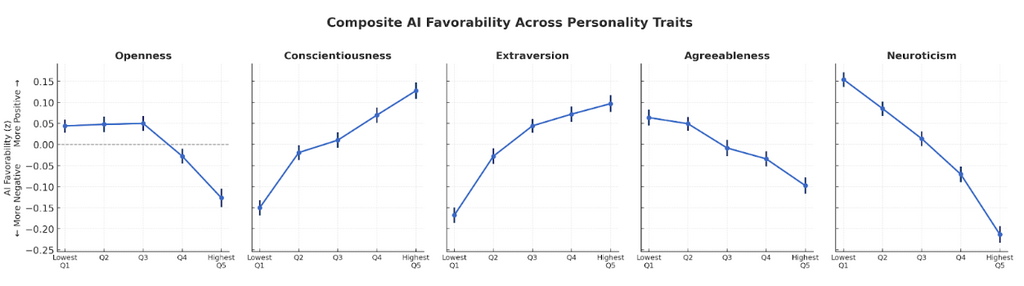
A surprising finding from the research is the “Openness Paradox” — the more creative and curious you are, the more suspicious you tend to be of AI.
Openness, one of the Big Five personality traits, describes people who are imaginative, curious, artistic and adventurous. You might assume this group would be the earliest and most enthusiastic adopters of AI, but survey data shows the opposite to be true.
In fact, skepticism about AI is most pronounced among those who score highest in Openness.
“Highly open individuals tend to explore underlying mechanisms, ambiguities, and second-order consequences,” said Cameron Berg, lead researcher at Truity. “This cognitive style yields critical curiosity rather than ‘this is exciting because it’s new.’ So instead of simply adopting AI as a creative tool, they interrogate what it means for things like authenticity, authorship or epistemic stability.”
"Highly open individuals tend to explore underlying mechanisms, ambiguities, and second-order consequences. This cognitive style yields critical curiosity rather than ‘this is exciting because it’s new.’ So instead of simply adopting AI as a creative tool, they interrogate what it means for things like authenticity, authorship or epistemic stability."
In other words, openness is about exploration, not blind optimism, and that distinction shows up clearly in the survey data.
Another possible factor: highly open individuals often follow nontraditional or creative career paths like the arts, freelance work or entrepreneurship. If their careers aren’t demanding rapid AI adoption, that gives these individuals more freedom to pause, explore, and decide for themselves whether AI enhances or disrupts their work.
This aligns with firsthand accounts from creatives like Christian R., a writer and designer, who described his cautious, push-pull relationship with AI: “I was skeptical at first, then truly dove in. After some time, I backed off, and I find myself in this back-and-forth dance as I figure out its limits and best use cases.”
For many high-openness individuals, core fears include threats to creative value or authorship, loss of artistic originality, and AI-generated sameness replacing individual taste or unique, human-centered perspectives.
“What's the point of sending something we didn't write… or me making a bit more money by sacking my administrator who has four kids?” said Sabine Z., the owner of a communications agency, in an interview with the BBC.
Sabine’s concerns aren’t pure emotion – they’re supported by data. Research published in the Harvard Business Review found that while AI adoption makes individuals more productive, it comes at the cost of creative thinking, which can reduce a person’s intrinsic motivation for work.
The HBR article warns, “If employees consistently rely on AI for creative or cognitively challenging tasks, they risk losing the very aspects of work that drive engagement, growth, and satisfaction.”
Although cautious, Christian R. sees the potential for creatives to find even more meaningful work in the AI era.
“The creatives' fear is that the client will bypass us entirely for slop. To which I say, great, fine,” he said. “ If customers want to go for something cheap and sloppy then have at it. There will always be customers who appreciate, value, and wish to craft as part of their brand.”
How Each Big Five Trait Predicts AI Attitudes
Openness isn’t the only personality trait that predicts how a person feels about artificial intelligence. Data shows that the other Big Five traits of Conscientiousness, Neuroticism, Extraversion and Agreeableness also play a role.
1. Conscientiousness: The Productivity Superusers
Out of everyone who participated in the survey, people high in Conscientiousness (those who are organized, disciplined and goal-oriented) are the most likely to have a positive opinion of AI and use it the most frequently, making this group the ultimate AI “superuser”.
Highly conscientious people see AI as the ultimate efficiency booster, says Berg, and it aligns with their preferences for structure and mastery.
“AI streamlines tasks and increases personal control,” he explained. “So for [highly conscientious people], AI is aligned with their motivational system.”
Conscientious individuals often use AI as a productivity tool, and see its role as more of a helpful assistant rather than a threat. Essentially, it can help them do their job better, faster, which supports their goal-oriented and ambitious nature.
2. Neuroticism: The Cautious Worriers
For people high in Neuroticism (those who are more sensitive to stress, uncertainty, or perceived threats), AI sparks more concern than excitement. Survey data shows that higher levels of this trait are linked to greater fear, negativity, and skepticism toward AI, especially when it comes to job security, accuracy, and the pace of change.
These individuals aren’t necessarily anti-technology; they’re just highly attuned to what could go wrong. Their response to AI is shaped less by hype or curiosity and more by a desire for predictability, control, and reassurance.
“Neuroticism isn’t about pessimism per se; it’s about vigilance,” says Berg. “From the data alone, we can infer that neurotic individuals are most concerned about loss of control, things going wrong, and the unpredictable or irreversible consequences of AI.”
Truity’s research was not the first to look at the link between Neuroticism and AI adoption. A 2024 paper published in the Academy of Management revealed that CEOs who score high in Neuroticism were initially more hesitant to invest in AI due to fear of making the wrong decision. However, they became significantly more likely to adopt AI after it proved its value, driven by fear of falling behind.
According to Berg, companies that sell AI technology or those that want to get neurotic employees onboard with AI integration should focus on reducing the emotional and cognitive threats, framing AI as a helpful tool, not a wild frontier.
“Skeptical groups respond strongly to perceived unpredictability,” said Berg. “Making AI systems more legible and dependable will move the needle.”
3. Extraversion: The AI Optimists
Another surprising finding from the research is that those who score high in Extraversion tend to have a more positive attitude when it comes to AI. Extraverts are energized by social interaction and external stimulation. They are the opposite of Introverts, who are energized by alone time and introspective activities.
One might assume that Extraverts would be skeptical of a tool that could ultimately replace human interaction (not such a far-fetched idea when people are already marrying their chatbots). But Berg explains that highly stimulating AI tools can be rewarding for Extraverts.
“Extraversion is about high stimulation, not preferring humans over tools. Extraverts gravitate toward anything that increases expression or momentum. AI supercharges those things.”
“Extraversion is about high stimulation, not preferring humans over tools. Extraverts gravitate toward anything that increases expression or momentum. AI supercharges those things.”
Extraverts often use AI as a springboard: something to spark energy, accelerate thinking and keep things moving. But there’s another reason those who are energized by social interaction may be attracted to AI: loneliness.
Rates of social isolation are at record highs. AI’s ability to play the role of friend, therapist, or even romantic partner may be especially attractive to those with high social needs that aren’t being met in our increasingly isolated and individualistic world.
The reasoning makes sense, but experts warn of potential consequences.
“AI can provide engagement and conversation,” said psychiatrist Marlynn Wei in an article for Psychology Today. “But it lacks genuine reciprocity and emotional presence. If AI replaces, rather than supplements, human relationships, it may deepen isolation rather than relieve it.”
4. Agreeableness: The Wild Card
Highly agreeable people — those who are warm, cooperative, and tuned in to the needs of others — tend to use AI a bit less frequently than their less agreeable counterparts. But interestingly, Agreeableness was the least predictive trait overall when it comes to AI attitudes or behaviors.
Why? Because values like kindness, trust, and cooperation don’t translate cleanly into how someone relates to technology. Berg explains, “Extraverts engage with AI because it empowers them; agreeable individuals might hesitate because their orientation is interpersonal care, not agency.”
In short, highly agreeable people value something AI can’t truly offer: genuine empathy. They might appreciate the technology’s usefulness in other areas, but simulated warmth doesn’t fully meet the needs of someone who’s wired for real interpersonal connection.
“AI might recognize that a particular decision would upset someone, but it cannot feel the weight of that decision or adapt its actions in the same way a human would,” writes John Nosta in an article for Psychology Today. “The emotional richness that comes with empathy is therefore something machines are unable to replicate, no matter how advanced they become.”
It’s also worth noting that highly agreeable people are disproportionately represented in professions built around human connection, such as teachers, therapists, social workers, and caregivers. In these roles, AI isn’t especially helpful for the most important parts of the job. When the work is relational rather than transactional, technology naturally plays a smaller supporting role.
The Emotional Landscape of AI
Across the entire dataset, people expressed a wide range of emotional responses, with the majority (54%) of respondents expressing a positive view of AI. Only about a quarter (26%) expressed a negative opinion.
Among the positive sentiments, practical and work-related benefits were the most common themes: efficiency, productivity, creative support, and greater access to information.
Eric B., who primarily uses AI to support his coding work, echoes these views. “I am optimistic about its utility,” he said. “AI’s ability to produce ‘tailored starting points’ is downright revolutionary and gets me past the first issue that plagues most creative work: just getting started!”
The top concerns were related to job loss, misinformation, unpredictable or irreversible consequences, and the loss of human connection.
"My initial reaction was that AI is soulless and is a contradiction with my business, which is all about human connection," Florence Achery, who owns a yoga studio, told the BBC. Many individuals like Achery are avoiding AI altogether, citing concerns that also include the environmental impact and energy consumption of AI.
Other skeptics remain curious. Christian R. describes his AI attitude as optimistic yet practical. Although cautious, he sees potential for transformative change in his own life and in society at large.
“It'll push people out of their comfort zone to find their broader genius beyond just pressing buttons for a living or staring at a screen,” he said. “I'm always begging for my job to be replaced. Kick me off the ledge, please.”
When it comes to the future of AI, the strongest personality predictors of optimism were high Extraversion and Conscientiousness. Neuroticism showed a clear link to pessimism, while high Openness was linked to greater skepticism and a more nuanced, less consistently optimistic outlook.
Berg describes it this way: “Optimism correlates with psychological agency: the sense that these tools help you act on your intentions. Pessimism correlates with uncertainty sensitivity.”
Another small but meaningful finding from the research is the role gender and age play in AI attitudes. Women were less likely than men to feel optimistic about AI, and adults over 55 were more likely to be skeptical, infrequent users. Females under 18 and over 55 were the most likely to have an unfavorable opinion of AI. More research is needed to determine the reasons behind these age and gender discrepancies.
Usage vs Attitudes: What People Say Isn’t Always What They Do
Like many of the individuals interviewed for this article, survey data revealed that many who are skeptical or cautious of AI still use it frequently, either because it’s required or suggested at work, or purely for convenience. Fifteen percent of respondents reported that they rarely use AI, while 45% use it occasionally and 40% use it frequently.
Many who are skeptical or cautious of AI still use it frequently, either because it’s required or suggested at work, or purely for convenience. Fifteen percent of respondents reported that they rarely use AI, while 45% use it occasionally and 40% use it frequently.
“I use AI almost daily,” said Christi S., who manages an emergency call center. “It helps reduce the amount of time it takes to think up emails or summarize lengthy forms of documentation.”
Interestingly, people’s stated attitudes toward AI only loosely predict how much they actually use it. Day-to-day usage is shaped much more by job requirements, access, and immediate practical needs than by how optimistic or skeptical someone feels. Even as a daily user, Christi expressed concern over AI taking human jobs, like many of the call center roles she currently supervises.
The survey research also found a link between the frequency of AI use and personality traits. People with higher Conscientiousness, as well as those with lower Openness and Neuroticism were the most likely to report using AI frequently or daily.
Conclusion: AI Attitudes Aren’t Random, They’re Rooted in Personality
Truity’s data suggests that our reactions to AI aren’t just shaped by headlines, job roles, or tech literacy, they’re deeply rooted in who we are. Whether someone feels energized, skeptical, anxious, or cautiously curious about AI often reflects long-standing personality patterns around goal-orientation, control, uncertainty and creativity.
It’s important to note that none of these responses are irrational or wrong. Each reflects a different way of navigating change in a world that’s evolving faster than most of us can fully process.
Understanding the role personality plays in AI attitudes creates space for more empathy and better conversations. Instead of asking whether someone is “for” or “against” AI, we can ask what they need in order to feel safe, empowered or inspired in the new AI era. Concerns should not be minimized, but explored and addressed by tech companies and organizations alike.
For individuals, we can explore our own reactions to AI and where they come from. Are you adopting AI because it makes you faster at your job without considering the potential ethical or psychological issues? Will refusing to use AI eventually cost you business or a job once the majority of people become superusers? These are difficult questions, but ones that individuals should be asking themselves as we move into an era of rapid artificial intelligence expansion at a global scale.
If you’re curious about your own patterns, reflecting on your Big Five personality traits (or taking the personality assessment) can be a powerful starting point. AI may be shaping the future of work and society, but how we respond to it begins with understanding ourselves.
Megan Malone is an executive coach, writer, and emotional wellness advocate with a Master’s in Organizational Psychology. As the educational content and training lead at Truity, she has delivered workshops and team trainings for leading organizations, helping people understand themselves and work better together. An INFJ and Enneagram 9, Megan lives in Dallas, Texas, with her husband and daughter. You can also find her on Substack.


